
Most people assume memory is about storing facts. AI can store facts better than you ever will, so why bother? Just ask the agent.
This sounds right but is wrong and insidiously so.
What memory actually does is build structure. When you memorise something, you're not filing it away — you're connecting it with everything else you have learned up to that point. A drummer doesn't memorise rhythms so they can recall them. They memorise them so they become automatic, so they can stop thinking about the beat and start thinking about the music. The memorisation is what creates the freedom. This is the automaticity that Justin Skycak of Math Academy talks about.
Skip that step and you never get the freedom. You're always asking the machine.
There's a deeper problem. José Luis Ricón has a useful taxonomy of knowledge. Facts you can Google — AI handles those. Context you can write into files — AI can maybe handle those too. But there's a whole category of knowledge that can't be written down at all. Polanyi called it tacit knowledge: "we know more than we can tell." You know how to ride a bike. You know when an argument smells wrong. But how do you explain any one of these? You can't put that in a markdown file.
The American government once spent millions trying to recreate a material used in nuclear weapons. They had the original instructions. They talked to the original team. It still took years, because the critical step was an impurity nobody had thought to document. The knowledge existed only inside people who'd done the work.
The current bet is that enough context engineering will get around this. Write enough files, build enough scaffolding, and the agent becomes you. But the things that make you valuable are precisely the things you can't externalise. Your taste. Your judgement. Your sense of when something is off. These come from years of doing the work yourself, and they atrophy when you stop.
There's a study from MIT that exemplifies this: People who used ChatGPT for essay writing showed measurably different brain activity with markedly less creative cognition and weaker connectivity. They were only saving time; all the while accumulating what the researchers call cognitive debt that—like sugar to teeth—rots the foundations of good thought.
The Industrial Revolution made physical labour optional, so we invented gyms. Something similar is happening now with mental labour, and we don't have the equivalent yet. But we do have the best practices since Cicero: spaced repetition, deliberate practice, the old memory techniques.
The people who will do best in the age of AI aren't the ones who outsource the most. They're the ones who've internalised enough to know what to ask for, notice when the answer is wrong, and see connections the machine can't. Memory is what builds that. It always has been and always will be.
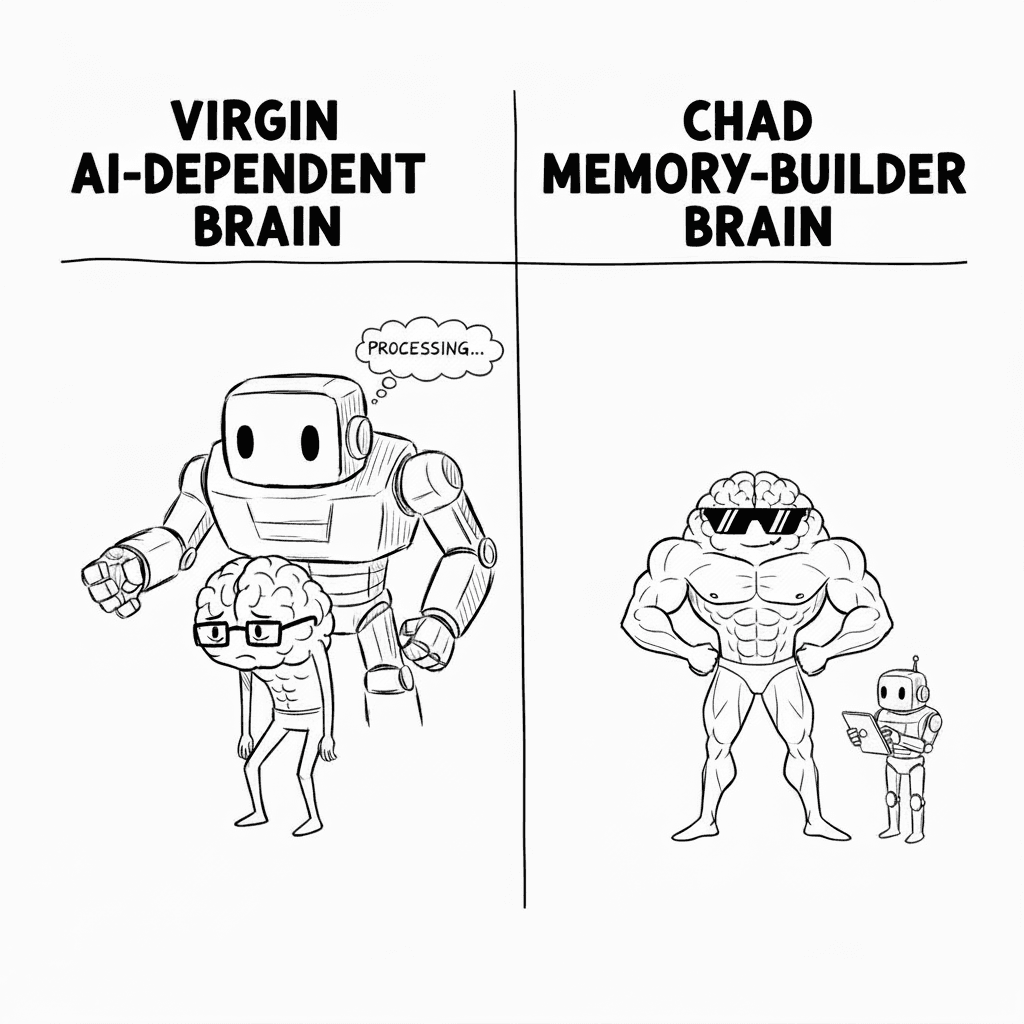
The Virgin Brain vs. the Chat Brain on AI. Don't be the one on the left.